
For entrepreneurs, managers, and small business owners, overanalyzing often leads to decision paralysis—stalling growth and innovation. Understanding two key behavioral economics concepts—bounded rationality and satisficing—can help break this cycle, enabling more timely, practical decisions that drive success.
Every small business needs a strategy rooted in a strong “core strategy and rules for winning” framework, as taught by Chris Gibbons. But adapting that strategy to your unique situation requires asking the right questions, applying creativity, and making decisions without getting stuck in endless analysis. A discussion about this often arises when I teach the Strategy Guidemap masterclass, Grow Your Business. Let's explore how bounded rationality and satisficing can support strategic growth, drawing from behavioral economics and modern strategy thinking.
Bounded Rationality: Making Decisions with Constraints
Coined by Herbert Simon in the 1940s and formalized in his 1957 book Models of Man, bounded rationality challenges the ideal of perfect rationality in classical economics. Simon argued that real-world decisions are shaped by limited cognitive ability, incomplete information, and time constraints.
Instead of endlessly optimizing, we make the best decision we can given our limits. For example, a manager may choose a vendor based on readily available data rather than exhaustive research, prioritizing progress over perfection. This more realistic lens is foundational in behavioral economics.
Satisficing: Choosing "Good Enough"
Also introduced by Simon, satisficing is the practical outgrowth of bounded rationality. Rather than chasing the perfect solution, decision-makers accept the first option that meets the minimum criteria. It’s a way to act decisively in complex, uncertain situations.
A consumer might, for instance, purchase a phone that’s “good enough” rather than compare every model on the market. Entrepreneurs and managers often benefit from the same approach—especially when speed and efficiency matter more than exhaustive certainty.
How These Ideas Work Together
Bounded rationality defines the constraints; satisficing provides the response. Together, they create a practical framework for avoiding decision paralysis. A business owner might satisfice by selecting a marketing strategy that fits the budget and meets core objectives, rather than seeking an elusive perfect plan.
By focusing on what's workable and timely, leaders can maintain momentum—aligning with strategy while adjusting tactics as conditions evolve.
Practical Applications for Small Businesses
Small businesses often operate with limited resources and time—ideal conditions for applying bounded rationality and satisficing. A small retailer might opt for a simple, cost-effective social media campaign instead of an in-depth market study. This isn’t cutting corners—it’s applying pragmatic, strategic thinking.
These concepts encourage creative, incremental approaches to growth: piloting new ideas, leveraging partnerships, and iterating quickly. By focusing on what’s achievable, small businesses can stay agile and effective in uncertain environments.
Imagination as a Strategic Tool
In his article Generating Creative Strategy Possibilities (Medium, May 2025), Roger Martin argues that distinctiveness in strategy comes from imagining a future world—not just analyzing the present. He recommends using analogies, tradeoffs, and anomalies to generate strategic possibilities.
For example, Olay’s repositioning was inspired by an analogy to Shiseido, a tradeoff between prestige and mass channels, and the anomaly of younger women using skin care. This kind of imaginative iteration aligns well with satisficing—exploring options and choosing promising paths without waiting for perfect data.
Direction, Insight, and Movement
The Strategy Guidemap article “Simplifying Strategic Decisions” emphasizes setting a clear direction based on your business model and rules for success. By asking the right questions—about markets, customers, trends—you generate insight. Bounded rationality and satisficing then help you act on that insight without stalling out.
Strategy defines the destination. Tactics are how you move—and must be adaptable. Using this framework, businesses can stay aligned while responding effectively to real-world conditions.
A Personal Note: Progress Over Perfection
As a side note, I’ll share a simple thought and a simple question—both of which have helped me move forward when I find myself bogged down in overanalysis in the quest for perfection.
The thought is this: “Don’t let pefection be the enemy of progress.” You may not have caught that—perfection is misspelled. It’s missing an “r.” I actually had that version written on the whiteboard in my office for several months. One day, my 11-year-old daughter came by, saw it, laughed, and said, “That’s clever, Dad.” The irony? I hadn’t realized I’d misspelled it. I still wonder how many clients sat in that office, just like me, and never noticed.
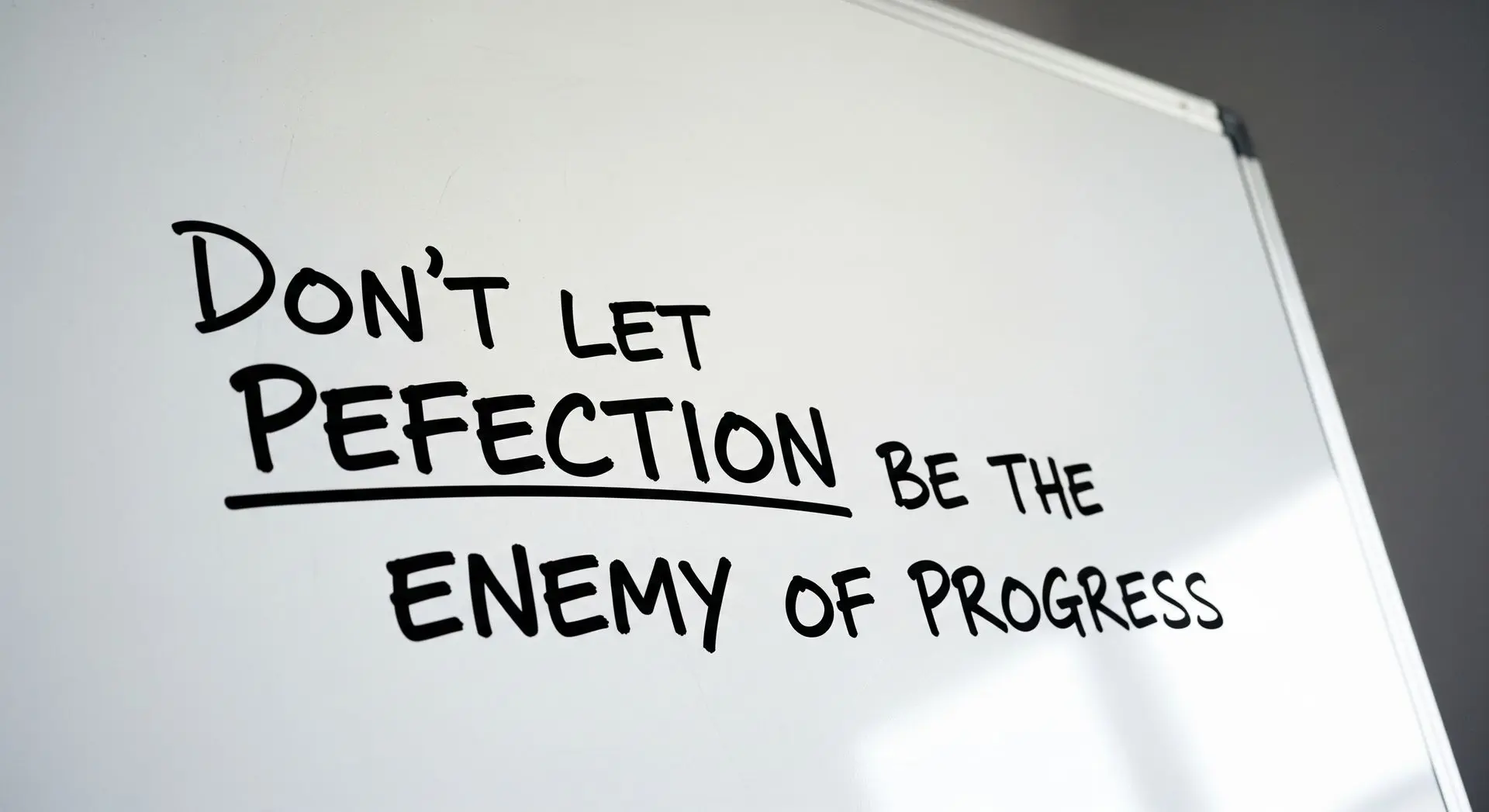
The takeaway? Don’t let the pursuit of flawless decisions slow you down. Especially when making tactical choices that already align with your broader strategy, ask yourself a simple question: “If this isn’t optimal, can I change it later?” It’s a powerful filter—and more often than not, the answer is yes. And if the decision is good enough for now, it’s good enough to keep you moving forward.
Moving Forward with Confidence
In a world of limited time and information, overanalysis is a real risk. But by embracing bounded rationality and satisficing, entrepreneurs and managers can make confident, creative decisions that drive strategic growth.
Rather than chasing perfection, the goal is to stay aligned with core strategy, act on insight, and iterate with intent. Strategy is a direction, not a script—and “good enough” decisions, made wisely, can lead to next steps and great outcomes.